
Reviewed · CASTLE TOURS
Copenhagen: Amalienborg Palace Museum Entry Ticket
Royal life gets wonderfully personal here. The Amalienborg Palace Museum takes you beyond grand ceremonies and into the private rooms of Denmark’s royal family, with preserved studies, dining rooms, photographs, furniture, and jewelry. For $19 per person, you get access to the museum for one day and can visit every included exhibition at your own pace.
I like the way the museum connects national history with ordinary family details. Christian X’s dark study feels like a real working room, while Queen Louise’s salon reveals a network of European family ties through paintings and photographs. I also like the clear route and the child-friendly audio guide, which makes the visit easier for families. The main drawback is scale: some people may find that there is not enough to see for the price, especially if you spend only 45 minutes inside.
In This Review
- Key points to know before you go
- Arriving at the palace square from Frederiksgade
- A museum built around people, not just palaces
- Christian X’s study, a room with a strong personality
- The dining room of Christian X and Queen Alexandrine
- Queen Louise’s private salon and European connections
- The Fabergé Chamber and Danish-Russian ties
- The Gala Hall, Amalienborg’s grandest interior
- The Frederik X exhibition and its date
- How long you need and how the $19 price feels
- Families, accessibility, and what to leave behind
- Who should book the Amalienborg Museum
- Should you book this Copenhagen palace visit?
- FAQ
- Where is the Amalienborg Palace Museum?
- Which palace building contains the museum?
- How much does admission cost?
- How long is the ticket valid?
- How long should I allow for the museum?
- Is a guided tour included?
- Is the museum wheelchair accessible?
- Can I bring a large bag or stroller?
- What happens when I arrive with an online ticket?
Key points to know before you go
- The museum occupies Christian VIII’s Palace, one of four buildings around Amalienborg Square.
- The royal rooms remain arranged as they were used, giving you a close look at daily life inside the monarchy.
- The Fabergé Chamber contains Russian jewelry from 1860 to 1917, including a coronation brooch made for Tsar Nicholas II.
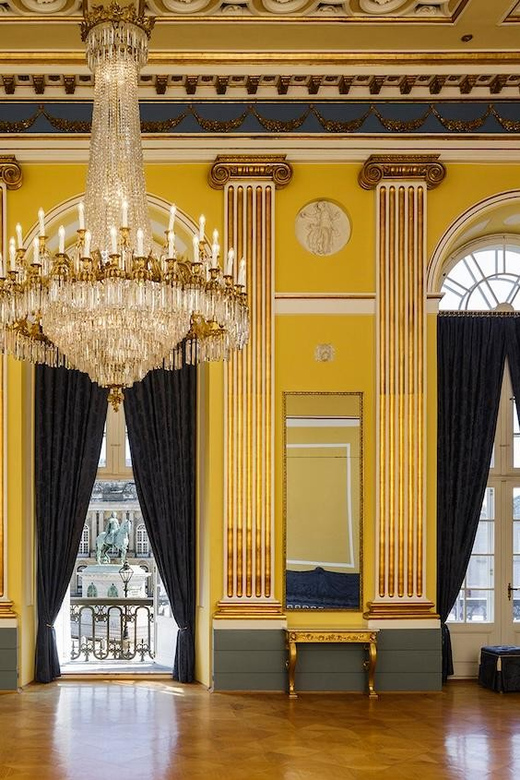
- The Gala Hall is the grandest room, with an eight-meter ceiling, gilding, and work by Nicolai Abildgaard and Bertel Thorvaldsen.
- Families have extra help, with an audio guide that includes content for children.
- Allow about 45 minutes to one hour inside, though the square and surrounding palace buildings add more time to your visit.
Arriving at the palace square from Frederiksgade
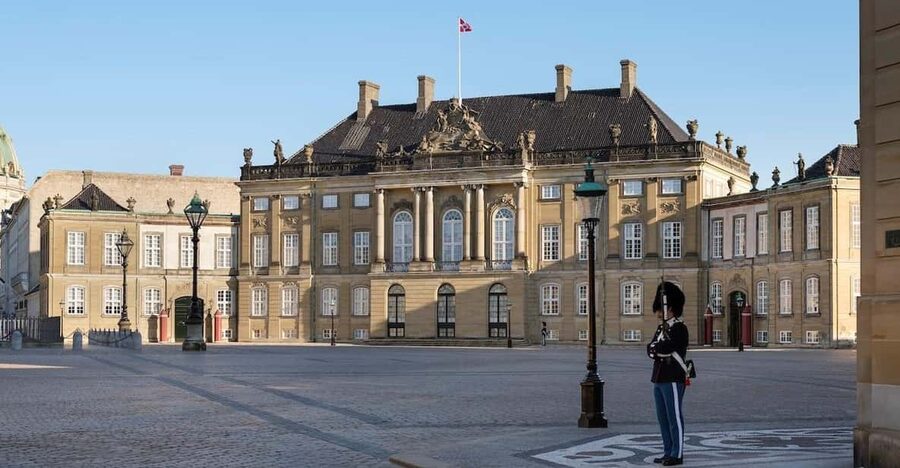
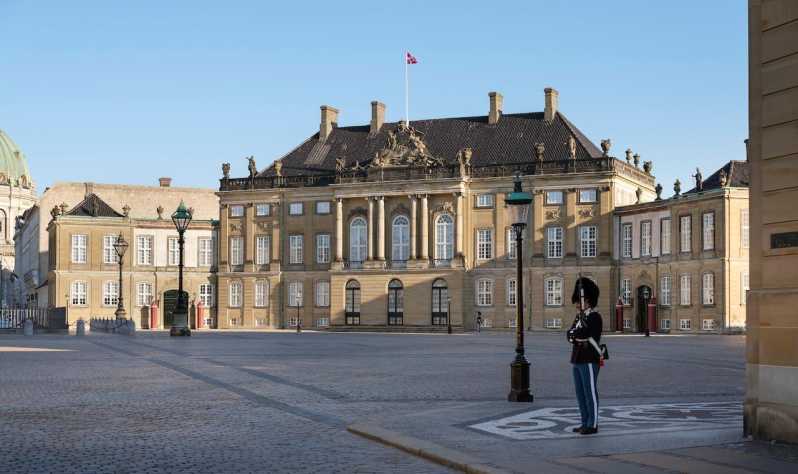
Amalienborg sits in central Copenhagen, and the palace square is part of the experience. The four palace buildings face the open octagonal space, creating an unusually formal setting in the middle of the city.
If you approach from Frederiksgade or the Marble Church, look for the first building on your left. That is the entrance to the Amalienborg Museum. This detail matters because the four matching palace fronts can make the entrance confusing at first glance.
The museum is in Christian VIII’s Palace. The Danish Royal Family resides at Amalienborg, but this museum presents rooms and collections connected with the monarchy rather than offering a tour of every palace building.
You should plan your arrival carefully. Before going upstairs to the exhibition, you need to go downstairs to the cashier and present and scan your online ticket. A QR code alone is not the final step. If you arrive more than 20 minutes late, the ticket is no longer valid, so avoid cutting your timing close.
The ticket is valid for one day, but you need to check the available starting times when booking. This gives you some room to fit the museum into a larger Copenhagen sightseeing day, but it does not mean you can ignore the assigned arrival time.
More Castle Tours in Copenhagen:
- Hamlet and Sweden Tour – Two Countries in one day !
★ 5.0 · 2,223 reviews - Copenhagen: Kronborg, Frederiksborg Castle and Roskilde Tour
★ 4.9 · 1,763 reviews - Copenhagen: Rosenborg Castle Entry Ticket
★ 4.6 · 381 reviews
A museum built around people, not just palaces
The museum covers roughly the last 150 years of Danish royal history. That time span gives the visit a personal shape. Instead of moving through empty state rooms with little context, you see how individual members of the family lived, worked, entertained, and displayed their connections.
I find this approach more engaging than a simple parade of royal portraits. A desk, dining table, framed photograph, or piece of jewelry can explain family life more clearly than a long panel of dates.
The rooms are preserved as though their occupants have just left. That phrase is easy to overuse in palace museums, but it fits especially well in the private rooms here. The setting gives you a sense of how the monarchy operated inside the palace, away from public ceremonies.
The route is well planned, with historical facts placed alongside the rooms and objects they explain. You can move through the museum without needing a guided tour. An audio guide is available, and children have their own material in each museum section, according to the available visitor information.
That makes the museum suitable for a mixed-age group. Younger children may not care about every royal date, but they can follow the rooms, objects, and audio segments in smaller portions. Adults can focus on the political and family connections.
Christian X’s study, a room with a strong personality
Christian X’s study is one of the most revealing rooms in the museum. It has dark walls and heavy furniture, the sort of decoration associated with a gentleman’s study around 1900.
The room also reflects Christian X’s background as an officer. You do not need a long explanation to sense that this was a working space with a serious tone. The preserved arrangement makes the room feel more specific than a generic royal office.
Christian X lived at the palace from 1899 until his death in 1947. His study remains as it appeared during his time there. That continuity is valuable because it turns a monarch from a name in a timeline into a person with a particular taste and working environment.
I would spend a few quiet minutes here rather than rushing through. Look at the furnishings as a group. The dark palette, formal arrangement, and military character tell you something about the period and the man who used the room.
The dining room of Christian X and Queen Alexandrine
The dining room belonged to Christian X and Queen Alexandrine. It appears almost exactly as it did during their years at the palace, from 1899 until Christian X’s death in 1947 and Queen Alexandrine’s death in 1952.
This room gives the museum a useful domestic counterpoint to the Gala Hall. The grand hall explains ceremony and public display. The dining room suggests the repeated routines of family life, even though the occupants were members of a reigning dynasty.
You can also see how preservation works here. The value is not only in the furniture itself, but in the arrangement of the room as a complete setting. A single table or chair can be interesting, but an entire dining room helps you picture how the space functioned.
If you are short on time, do not skip the private rooms in favor of the grand spaces. They are less dramatic at first glance, but they often provide the clearest sense of the family behind the crown.
More Museums in Copenhagen:
- Copenhagen: National Museum of Denmark Entry Ticket
★ 4.5 · 960 reviews - Exhibition – Home of Carlsberg
★ 4.5 · 281 reviews - Copenhagen: Danish War Museum Entry Ticket
★ 4.7 · 106 reviews - Copenhagen: MACA Art Museum Entry Ticket
★ 4.7 · 77 reviews
Queen Louise’s private salon and European connections
Queen Louise’s private salon dates from around 1895 and reflects the modern interior decoration of that period. It is a lighter, more personal room than Christian X’s study.
Paintings and framed photographs on the tables point to Queen Louise’s family life and her close ties across Europe. This is where the museum’s family story grows beyond Denmark. Royal marriages linked courts together, and the objects in the salon help make those relationships visible.
For me, the photographs are particularly useful because they bring scale to the royal family. Portraits can feel formal and distant. Photographs placed in a private salon suggest correspondence, visits, relatives, and a much wider family circle.
The salon is also a reminder that palace interiors change with their occupants. Christian X’s study feels stern and masculine, while Queen Louise’s salon reflects a different taste and purpose. Seeing both rooms close together makes the contrast easy to understand.
The Fabergé Chamber and Danish-Russian ties
The Fabergé Chamber contains hand-crafted Russian jewelry made between 1860 and 1917. The collection focuses on the close ties between the Danish and Russian monarchies.
The most notable object described here is the Fabergé coronation brooch, created for the coronation of Tsar Nicholas II. A small piece of jewelry can carry a surprising amount of political and family history. It points to the connections between royal courts and the ceremonial world surrounding imperial power.
This room is a good example of why the museum is more than a collection of Danish furniture. The monarchy existed within a network of European dynasties, and the jewelry offers a compact way to see those links.
Do not expect a vast jewelry exhibition. The appeal is the quality, craftsmanship, and story behind the pieces, not sheer quantity. If you enjoy decorative arts, royal objects, or the connections between European courts, this room may be one of the highlights.
The Gala Hall, Amalienborg’s grandest interior
The Gala Hall provides the museum’s biggest visual change. With an eight-meter ceiling, lavish gilding, and a view toward the palace square, it has the scale you expect from a royal ceremonial room.
The Royal Family commissioned Nicolai Abildgaard to design the interior in 1794. Sculptures by Bertel Thorvaldsen add to the room’s formal character. These names matter because the hall is not simply decorated. It represents a deliberate artistic statement commissioned for the monarchy.
The room is likely to be the most immediately impressive part of the visit. Look upward, then back toward the palace square. The height and decoration make it clear how royal power was meant to appear in public settings.
Still, the Gala Hall is only one part of the experience. If you judge the museum by this room alone, you may miss its more unusual strength, which is the contrast between public ceremony and private life.
The Frederik X exhibition and its date
A special exhibition titled Frederik X: King of Tomorrow was scheduled at the museum from March 22 through September 8, 2024. It marked the succession of the Danish throne on January 14 and presented a portrait of the new king through photographs, objects, video clips, paintings, and sound.
Because those dates have passed, you should not assume this exhibition is still available. Check the current exhibition information before booking if Frederik X is the main reason for your visit.
The exhibition format is worth noting because it shows how the museum can change over time. The permanent rooms focus on the monarchy across generations. A temporary display about a new king adds current events, media, and a more contemporary presentation.
How long you need and how the $19 price feels
Most people should allow 45 minutes to one hour inside the museum. That estimate comes from the available visitor experience and is realistic for a steady visit through the rooms and exhibitions.
You can spend longer if you read every historical panel, listen to the audio guide, or take time with the jewelry, photographs, and interiors. You can also spend additional time outside in Amalienborg Square, where the palace layout is part of the attraction.
At $19 per person, the price is reasonable if you enjoy royal history, historic interiors, or decorative arts. It becomes less convincing if you expect a large palace complex with many halls and extensive grounds.
The strongest value comes from the quality of the preserved rooms and the fact that the ticket includes all exhibitions. You are not paying only to glance at a single ceremonial room. You get the Gala Hall, private apartments, the Fabergé Chamber, and the historical displays in one visit.
That said, the museum is not huge. If your ideal palace visit lasts several hours, this may feel brief for the cost. I would pair it with time in Amalienborg Square and nearby Copenhagen sights rather than treating it as a full-day attraction.
Families, accessibility, and what to leave behind
The museum is wheelchair accessible. Families may find the child-focused audio guide useful, especially because each section has content designed for younger listeners.
Large bags, large purses, backpacks, luggage, and oversize items are not allowed inside. Baby strollers are also not allowed, and food and drinks cannot be taken into the museum. Pets are not permitted, although assistance dogs are allowed.
These rules can affect your timing. If you are carrying luggage or a large day bag, arrange storage before arriving rather than discovering the problem at the entrance. Keep your ticket easy to access because you need to scan it at the downstairs cashier before continuing upstairs.
The museum does not include a guided tour. You visit independently, using the displays and audio material to set your own pace. That is a benefit if you want freedom, but visitors who prefer a guide explaining every room may find the experience less satisfying.
Who should book the Amalienborg Museum
I would recommend this museum to you if you enjoy:
- Royal families and European dynastic connections
- Historic interiors preserved in place
- Decorative arts, jewelry, and court objects
- Short cultural visits in central Copenhagen
- Family attractions with child-friendly audio content
- Museums that connect personal belongings with national history
You may want to skip it if you are looking for extensive gardens, a very large palace, or a long guided tour. The museum is focused and fairly compact, not an all-day royal complex.
It is also a good choice when you want something more personal than a standard sightseeing stop. Christian X’s study, Queen Louise’s salon, and the family dining room give the visit a human scale. The royal title matters, but the rooms are what make the story work.
Should you book this Copenhagen palace visit?
Book it if the idea of seeing real royal living spaces appeals to you more than simply photographing a palace exterior. The preserved rooms, Fabergé jewelry, family photographs, and Gala Hall offer a well-balanced look at Danish monarchy across generations.
At $19, I consider it a fair purchase for people who will take their time and combine the museum with the palace square. Families also have a good reason to consider it, since the child-friendly audio guide can make the historical material easier to follow.
Skip it if you want a very large collection or expect several hours of entertainment from the ticket alone. For most visitors, the museum works best as a focused one-hour stop within a larger Copenhagen day.
FAQ
Where is the Amalienborg Palace Museum?
The museum is in Christian VIII’s Palace at Amalienborg in central Copenhagen, in the Zealand region of Denmark.
Which palace building contains the museum?
The Amalienborg Museum is part of Christian VIII’s Palace, one of the four palaces that make up Amalienborg.
How much does admission cost?
The entry ticket costs $19 per person.
How long is the ticket valid?
The ticket is valid for one day. You need to check availability for the starting times offered when booking.
How long should I allow for the museum?
Plan on about 45 minutes to one hour inside. You may spend longer if you use the audio guide, read the displays carefully, and visit every exhibition.
Is a guided tour included?
No. The ticket includes museum entry and access to all exhibitions, but it does not include a guided tour.
Is the museum wheelchair accessible?
Yes, the Amalienborg Museum is wheelchair accessible.
Can I bring a large bag or stroller?
No. Large bags, large purses, backpacks, luggage, oversize luggage, and baby strollers are not allowed inside.
What happens when I arrive with an online ticket?
You need to go downstairs to the cashier and present and scan your online ticket before going upstairs to the exhibition. If you arrive more than 20 minutes late, the ticket is no longer valid.
Newly added in Copenhagen
- Private Transfer Copenhagen Airport CPH to Copenhagen by Sedan★ 4.5 · 3 reviews
- Castles of Kronborg and Frederiksborg from Copenhagen by Car★ 4.5 · 3 reviews
- Copenhagen: Old Town and Nyhavn Private Family Tour★ 4.7 · 3 reviews
- Copenhagen: Evening Gourmet Walk with Food & Drinks Tasting★ 5.0 · 3 reviews
- The Forgotten Giants Private Tour★ 5.0 · 3 reviews
- Copenhagen Craft BeerWalk City Center★ 4.4 · 3 reviews
- Copenhagen: Express Walk with a Local in 60 minutes★ 4.6 · 3 reviews
- Departure by Luxury Vehicule Copenhagen to Copenhagen airport CPH★ 5.0 · 3 reviews
Castle Tours, compared.

Hamlet and Sweden Tour – Two Countries in one day !
Read our review →
Kronborg, Frederiksborg Castle and Roskilde Tour
Read our review →

Full-Day; Castle, Palace, Cathedral & Viking ships Tour
Read our review →
Kronborg (Hamlet Castle) & Frederiksborg Castles: PRIVATE TOUR
Read our review →
Copenhagen City & Christiansborg Palace Private Walking Tour
Read our review →Browse the lists this tour appears in