
Reviewed · SELF-GUIDED TOURS
Explore Copenhagen: Self-Guided Audio Tour
Seven classic Copenhagen sights, one phone, and no fixed group make this a handy way to get oriented in the Danish capital. I like the useful audio directions between stops and the freedom to pause, wander, or begin somewhere other than the suggested starting point. I also like the mix of royal buildings, churches, theatres, and city history. The main caution is sound quality: background effects can muffle the narrator, and the files need to be downloaded and prepared before you begin.
At $15.29 per person, this is a modest-cost introduction to central Copenhagen. You are paying for structure and historical context, not admission tickets, transport, or a human guide. If you prepare the files in advance and bring headphones that work well outdoors, the tour can be good value. If you want lively conversation or detailed help inside the buildings, this will feel thin.
In This Review
- Key points at a glance
- What this Copenhagen audio tour is really like
- City Hall Square and the story of Copenhagen’s civic center
- The Round Tower and its unusual spiral ramp
- Rosenborg Castle and Christian IV’s building program
- Marble Church and the grand plan for Frederiksstaden
- Amalienborg and the Danish royal residence
- The Royal Danish Theatre’s long performing arts tradition
- Christiansborg and the Royal Kitchens
- Audio quality and how to prepare your phone
- Price, timing, and practical value
- Who should book this Copenhagen walk?
- Should you book this self-guided Copenhagen tour?
- FAQ
- Where does the tour start?
- Where does the tour end?
- Can I choose a different starting point?
- What time does the tour start?
- How long does the experience take?
- Is the tour guided in person?
- What is included in the price?
- Are admission tickets included?
- Is transportation included?
- What language is available?
- Do I need to download anything before starting?
- Can I cancel for a full refund?
Key points at a glance
- Seven central sights in about two to three hours: The route links City Hall Square, royal palaces, Marble Church, the Royal Danish Theatre, and Christiansborg.
- Audio directions are included: The tour provides more than basic GPS triggers, with spoken guidance to help you reach each destination.
- The tour works offline after preparation: A download package contains a map, 13 audio files, and other files, so you are not relying entirely on a live phone signal.
- Admission is separate: Every listed stop is marked with admission not included, and the tour price covers only the audio material and map.
- You control the pace: You can choose your own start and finish according to your schedule, although the suggested endpoint is Tivoli Gardens.
- English only, with no physical guide: This suits independent visitors who like background information without joining a group.
What this Copenhagen audio tour is really like
This is best understood as a walking framework rather than a full guided excursion. The audio gives you a sequence of places, explains what you are seeing, and helps direct you onward. You can listen at each stop, take photographs, pause the recording, or skip an attraction if your day changes.
The advertised duration is two to three hours. Each of the seven main stops is allocated about 15 minutes, which adds up to roughly 105 minutes before walking time. That makes the overall estimate sensible, but your actual visit can run longer if you enter a building or spend time around the squares.
You begin at Rådhuspladsen, or City Hall Square, with a suggested start time of 9:00 a.m. The route finishes at Tivoli Gardens, though the self-guided format lets you set your own starting and ending point. That flexibility is useful if your hotel, railway station, or sightseeing plans put you somewhere else in central Copenhagen.
The experience is designed for your smartphone. Before setting out, you need to download the material from the instructions in your ticket. The supplied package includes a zip file, a map, 13 audio files, and additional files. This preparation matters. Do not wait until you are standing in City Hall Square trying to sort out downloads, file extraction, and playback.
One particularly useful feature is that the audio includes directions to the next sight. That is more practical than a system that simply announces that you have wandered off course. The map gives you a second way to check your position, which is helpful when the phone signal is weak or when you want to plan a short pause.
More self-guided routes around Copenhagen:
- Copenhagen: Hop-On Hop-Off Bus Tour with Audio Guide
★ 4.2 · 100 reviews - Copenhagen Little Mermaid Exploration Game and Self-Guided Tour
★ 4.0 · 36 reviews - Monstour: A Self-Guided Audio Tour of Danish Folk Legends
★ 4.5 · 19 reviews
City Hall Square and the story of Copenhagen’s civic center
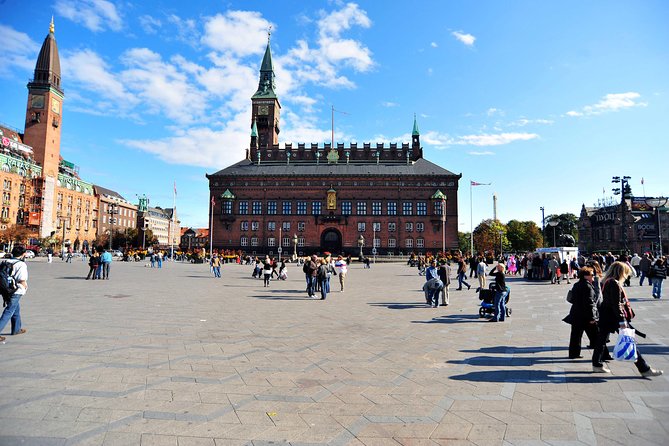
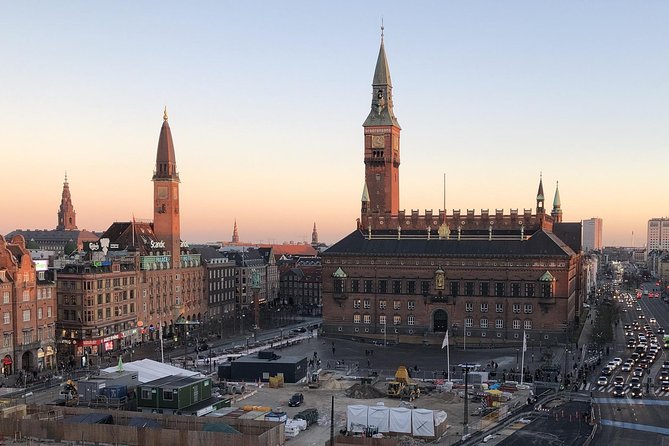
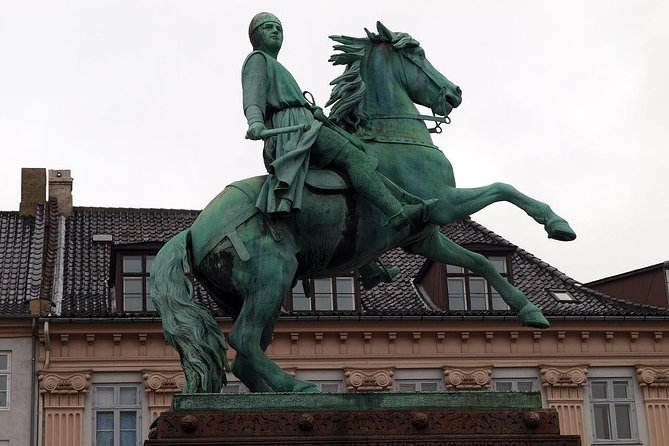
Your first stop is Copenhagen City Hall, facing the city’s largest square. The building is easy to recognize, with an ornate brick exterior, a clock tower, and a gilded statue of Bishop Absalon above the front balcony.
The audio places the building in the National Romantic style, a Danish architectural movement that looked to local materials, older traditions, and a strong sense of place. Architect Martin Nyrop designed the hall, drawing inspiration from the City Hall in Siena, Italy. That connection gives you a useful comparison: Copenhagen’s civic building is not simply a government office, but part of a wider European tradition of grand public architecture.
The stated visit time is 15 minutes, and that is enough for an exterior look and the basic explanation. Admission is not included, so the experience does not promise an interior tour. If you want to spend time studying the brickwork, clock tower, or square, pause the audio rather than feeling tied to the schedule.
City Hall Square is a practical starting point because it gives you a broad urban setting before the route moves toward royal Copenhagen. You get a sense of the city’s public face first, then begin seeing the buildings connected with monarchy, worship, performance, and government.
The Round Tower and its unusual spiral ramp
The Round Tower offers one of the more distinctive stops on the route. Built in the 17th century, it formed part of the Trinitatis Complex along with Trinitatis Church and an academic library serving nearby Copenhagen University.
The library opened in 1657 and once held the university’s entire collection, around 10,000 books. That detail helps explain why this was more than an isolated tower. It was part of an intellectual center that joined astronomy, religion, and learning in one complex.
The tower served as an astronomical observatory, but its most memorable feature for many people is the route upward. Instead of a normal staircase, it has a spiral ramp leading toward the top. The audio should help you notice how unusual that design is, even if you do not pay the separate admission fee to enter.
Again, the planned stop is about 15 minutes, and admission is extra. You can listen outside and continue, or choose to enter on your own and spend more time there. The self-guided setup makes that decision easy, but it also means you must manage your own timing and ticket purchases.
This is a good example of the tour’s wider strength. It does not focus only on famous royal residences. It includes a place where architecture and education tell part of Copenhagen’s story.
Rosenborg Castle and Christian IV’s building program
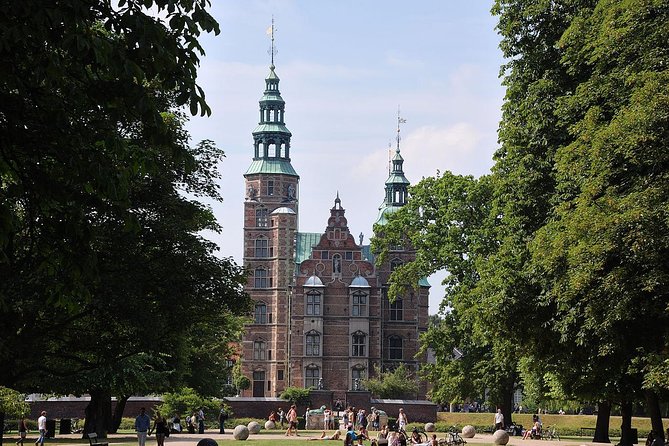
Rosenborg Castle was one of the many projects commissioned by King Christian IV. Its Dutch Renaissance design uses tall gables and spires, giving the building a strong vertical profile that differs from the more restrained civic architecture at City Hall.
Construction continued through several stages. Although the castle was completed earlier, it did not reach its present form until 1624. That small point is useful because historic buildings often look like single projects when they were actually changed over many years.
The 15-minute audio stop gives you a compact introduction to the castle’s appearance and royal connection. Admission is not included, so you will need to decide if the exterior explanation is enough or if you want to buy entry separately. The tour does not include an inside visit, and it does not provide a physical guide to answer questions at the gate.
I like the way Rosenborg follows the Round Tower. You move from a place built for study and astronomy to a royal residence shaped by a powerful king’s architectural ambitions. The stop is short, but the contrast gives the route a clear rhythm.
More audio-guided walks in Copenhagen:
Marble Church and the grand plan for Frederiksstaden
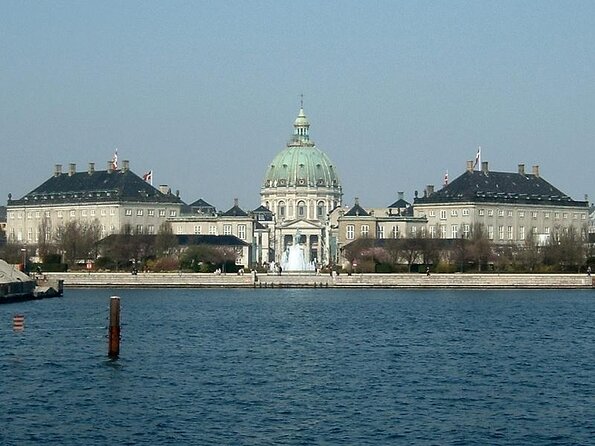
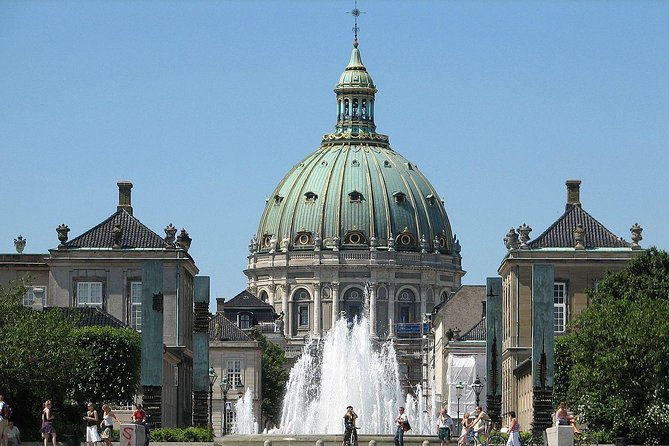
Frederiks Kirke is better known as the Marble Church. Its dome is the largest church dome in Scandinavia, making this one of the route’s most imposing visual stops.
The official name, Frederiks Kirke, refers to King Frederik V. In 1748, Frederik began planning Frederiksstaden, a grand district that would reshape this part of Copenhagen. The church was intended to form part of that larger urban vision, not merely to serve as a stand-alone place of worship.
The audio gives you the name, scale, and royal setting you need to appreciate the building from outside. The planned time is 15 minutes, and admission is again not included. If you want to enter, check the separate arrangements yourself, since this experience covers neither tickets nor transportation.
This stop is particularly useful if you enjoy architecture. The dome gives the church an immediate visual identity, while the connection to Frederiksstaden explains why the surrounding royal buildings feel planned rather than randomly placed.
Amalienborg and the Danish royal residence
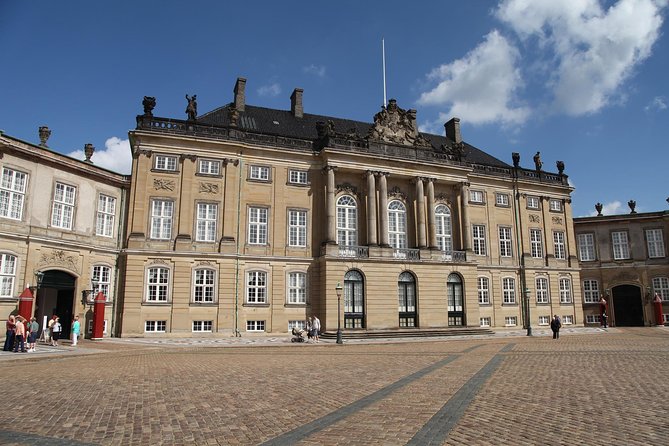
Amalienborg Palace is the current home of the Danish royal family. The complex you see today was designed as the crowning feature of Frederiksstaden, with four buildings arranged around an octagonal space.
The first palace on the site was built between 1669 and 1673 by Queen Sophie Amalie, wife of King Frederik III. That original palace did not survive in its first form. Frederik V dismantled it and replaced it with the octagonal complex associated with Amalienborg today.
The audio stop is scheduled for about 15 minutes. That is enough to understand the layout and royal role, but not enough for an unhurried palace visit. Admission is not included, and the tour does not guarantee access to interior rooms or palace displays.
You will get the most from this stop if you pay attention to the relationship between the buildings and the open space at their center. The audio helps turn a royal residence into an understandable plan: a palace district shaped by Frederik V, rather than simply a single grand house.
Because Amalienborg remains a working royal residence, the experience is also a reminder that Copenhagen’s royal story is not confined to museums. Still, you should keep expectations realistic. This is an exterior-focused audio stop unless you arrange and pay for additional admission yourself.
The Royal Danish Theatre’s long performing arts tradition
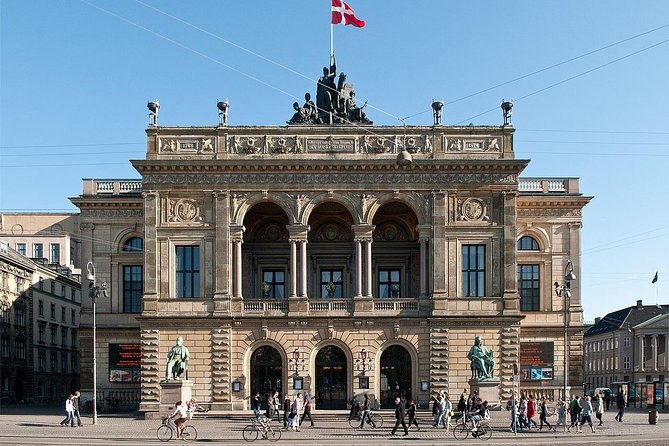
The Royal Danish Theatre Play House brings a different subject into the route: performance. The first theatre on this site opened in 1748. It held 800 people and employed eight actors and four actresses, with French comedies making up much of the program.
That early theatre soon proved too small for Copenhagen. It was rebuilt in 1774 to accommodate a larger audience, and the Royal Danish Theatre became a home for ballet, opera, and the royal orchestra as well as spoken theatre.
The audio gives this stop a useful human scale. Numbers such as the original audience size and small company make the institution feel less abstract. You can picture a theatre that began with a limited cast and a narrow performance program, then expanded as the city’s appetite for the arts grew.
The planned listening time is 15 minutes. Admission is not part of the price, so you should not expect a performance ticket or an interior tour. The value here is the historical setting and the chance to see how the arts fit into the city’s royal and civic life.
For me, this stop also prevents the route from becoming a parade of palaces. Copenhagen is presented as a city of performance as well as monarchy, worship, and public administration.
Christiansborg and the Royal Kitchens
The final listed attraction is the Royal Kitchens of Christiansborg Palace. Christiansborg sits on a site occupied by several earlier castles, making it one of the strongest places on this route for understanding layers of Copenhagen’s past.
In 1167, Bishop Absalon built the first castle on the island. The Hanseatic League later destroyed it, and Copenhagen Castle was built over the ruins. That castle lasted for several centuries and is linked with the Blue Tower, where Leonora Christina, daughter of Christian IV, was held captive for nearly 22 years.
The audio names the remains of four earlier castles beneath Christiansborg. That fact gives the palace more weight than its present exterior alone might suggest. You are hearing about repeated rebuilding, political change, and the way one seat of power replaced another.
The stop is planned for 15 minutes, with admission not included. Since the attraction named here is the Royal Kitchens, you should treat the audio as an introduction rather than a ticketed palace visit. If you want to see the kitchens or other parts of Christiansborg, you will need to arrange entry separately.
This is a fitting final historical stop. The route begins with Absalon’s statue at City Hall and ends with Absalon’s first castle as part of the story behind Christiansborg. The connection ties the itinerary together without requiring a long lecture.
Audio quality and how to prepare your phone
The strongest practical advice is to prepare everything before leaving. Download and unzip the files, check that all audio tracks open, save the map where you can find it, and make sure your phone has enough battery for a two to three hour walk.
The audio quality may not be consistently strong. Background sound and effects can make the speaker difficult to hear, and playback may become staticky at high volume. The narration may also sound like a script being read rather than a lively conversation.
That does not erase the value of the information, but it changes how you should use the tour. Good headphones can help, though you should still keep the volume at a level that lets you notice traffic and other sounds around you. If a section is hard to hear, use the map and written files rather than assuming the whole experience has failed.
The package contains 13 audio files for seven principal sights. That suggests you may receive extra tracks or separate direction files. Organizing them before you start will save time and frustration.
Price, timing, and practical value
At $15.29, the price is reasonable if you want a low-cost orientation to central Copenhagen. You receive audio files, a GPS map, and self-paced access. You do not receive attraction tickets, transport, food, drinks, or an audio device.
The price is less attractive if you plan to enter several of the buildings. Since all listed stops exclude admission, your total day cost can rise quickly if you add tower, palace, church, theatre, or Christiansborg tickets. The tour works best as an exterior introduction with optional paid visits added according to your interests.
The suggested duration of two to three hours gives you a manageable half-day plan. You can keep moving and stay close to that estimate, or pause the audio and extend the route. The 15-minute allocation at each stop is a guide, not a strict appointment.
The experience is offered in English only. It is suitable for someone who can walk at a moderate level and use a smartphone independently. Service animals are allowed, and the route is near public transportation. The maximum stated capacity is 50 people, though a self-guided format means you are not expected to move as one physical group.
Free cancellation is available up to 24 hours before the experience start time. Changes or cancellations inside that period are not accepted for a refund, so pay attention to local time when making plans.
Who should book this Copenhagen walk?
I would choose this tour if you want a clear first look at Copenhagen without paying for a private guide. It suits independent visitors, budget-conscious sightseers, and anyone who prefers to stop for coffee, photographs, or a spontaneous detour.
It is also useful on a first day in the city, when you want a broad introduction to major civic, royal, religious, and cultural sights. The spoken directions are a real help, especially compared with audio products that rely entirely on automatic GPS prompts.
I would not choose it if you need polished sound, a warm narrator, or detailed answers about what you see. It is also not the right pick if your main goal is a fully guided interior visit to the palaces, tower, church, or Christiansborg.
Should you book this self-guided Copenhagen tour?
Book it if you value independence and want a structured route for $15.29. Download the files early, test the audio, bring a charged phone, and remember that every admission fee is separate.
Skip it if you prefer a human guide, strong storytelling, or a single ticket covering the sights. For the right user, this is a practical and affordable way to connect Copenhagen’s main landmarks, with enough historical detail to make the buildings easier to read.
FAQ
Where does the tour start?
The suggested starting point is Rådhuspladsen, 1599 Copenhagen, Denmark.
Where does the tour end?
The stated endpoint is Tivoli Gardens at Vesterbrogade 3, 1630 København V, Denmark. Since the tour is self-guided, you can choose your own ending point according to your schedule.
Can I choose a different starting point?
Yes. The self-guided format allows you to decide your starting point and ending point.
What time does the tour start?
The stated start time is 9:00 a.m.
How long does the experience take?
The approximate duration is two to three hours.
Is the tour guided in person?
No. It is a self-guided audio tour with no physical guide included.
What is included in the price?
The price includes audio files and a GPS map.
Are admission tickets included?
No. Admission fees are not included for the listed attractions.
Is transportation included?
No. Transportation is not included.
What language is available?
The tour is available only in English.
Do I need to download anything before starting?
Yes. The instructions advise you to download the audio file and have it ready before beginning. The download package includes a map, 13 audio files, and other files.
Can I cancel for a full refund?
Yes, if you cancel at least 24 hours before the experience start time. Cancellations or changes made less than 24 hours in advance are not eligible for a refund.
Newly added in Copenhagen
- Private Transfer Copenhagen Airport CPH to Copenhagen by Sedan★ 4.5 · 3 reviews
- Castles of Kronborg and Frederiksborg from Copenhagen by Car★ 4.5 · 3 reviews
- Copenhagen: Old Town and Nyhavn Private Family Tour★ 4.7 · 3 reviews
- Copenhagen: Evening Gourmet Walk with Food & Drinks Tasting★ 5.0 · 3 reviews
- Copenhagen Craft BeerWalk City Center★ 4.4 · 3 reviews
- The Forgotten Giants Private Tour★ 5.0 · 3 reviews
- Departure by Luxury Vehicule Copenhagen to Copenhagen airport CPH★ 5.0 · 3 reviews
- Copenhagen: Express Walk with a Local in 60 minutes★ 4.6 · 3 reviews
Self-Guided Tours, compared.
The Ancient Viking Stronghold of Aros: A Self-Guided Audio Tour in Aarhus
Read our review →
Copenhagen Little Mermaid Exploration Game and Self-Guided Tour
Read our review →
Monstour: A Self-Guided Audio Tour of Danish Folk Legends
Read our review →
Ghosts of Aalborg: The Witch Trial Exploration Game
Read our review →
Copenhagen Self-Guided Murder Mystery Tour by the Round Tower
Read our review →
Copenhagen Christiania: Hidden Stories Self-Guided Adventure
Read our review →
Copenhagen Royal Conspiracy Exploration Game and Tour
Read our review →Browse the lists this tour appears in